This is the first post that covers one of a few of the methods I used when writing the series. It contributes in making the story across all media feel lived-in and like a place that you could actually visit.
Throughout the Charles Mandrake series, one of the most apparent feelings that readers get is that the entire world feels lived-in and real. Almost like East Bay and Skelderheim were actual places that you could visit. This wasn’t an accident by any means, and I designed it to feel this way.
Consistency is the Key to Making a Place Feel Real.
Authors, like movie directors know that there are certain things that have to be consistent throughout a scene or over a series of scenes. Like if Johnny puts his phone in his left pocket, shakes someone’s hand, and then pulls his phone out from the right pocket, the viewer or reader might not catch the phone’s teleportation, but they will feel like something was off. It breaks the illusion fast.
In writing the Mandrake series, I paid a lot of attention to consistency.
There are many techniques that I used, and this is one of the later and smaller ones.
Actually mapping the town is completely transparent on page in the story, but for a town that the characters live in and come back to three times in the series, and now, on the East Bay site, location consistency is extremely important to me.
I do know that many stories don’t actually need this level of detail. Usually, the locations serve the plot. They are there, they are a place where characters go, things happen, and that’s it.
East Bay is a character. It’s a living town. Mrs. Johnson owns East Bay Bakery and makes pies that don’t go mushy, even when reheated. That’s consistent across all 4 books and the site. Dockside Salvage sits on Pier 9, and Ira Finch lives in the apartment above and owns the shop. Anna, Todd and Charles always take the same streets when moving around. Nothing important”warps” or “teleports”. Now, one might say it’s not that big a deal, and for most novels, they’re right.
But for the Charles Mandrake world, East Bay must always feel like East Bay. That’s a decision I made when I decided that the town should be a character.
The route from Anna’s house to Finch’s Dockside Salvage is exactly 3,725 feet, and at her usual walking speed of 3.1 miles per hour, it takes her 13 minutes and 39 seconds to get there. Her house sits on Bennington between Oak and Maple. She walks north on Bennington, cuts east on Remmington Street, then left on Pier Street. From there, it’s 950 feet up to Dockside Salvage.
But let’s say Anna was going to Mel’s as she usually does for work in the mornings. She heads south from her house on Bennington, up to Oak. East on Oak to Main Street. Turn right and walk 1,800 feet south on Main Street until she hits the three-way intersection of Main, BayView, and Constitution Avenue. Mel’s Over Easy sits right there. The whole walk is 3,325 feet, and takes Anna 12 minutes and 8 seconds to arrive at work.
But how do I know this? How do I also know that East Bay hardware is 170 feet south of the Gull and Anchor Gift Shop?
I took the time to map the town out. Down to the foot.
None of those numbers ever appear in the books. They’re simply the framework underneath the prose. If Anna’s walk takes twelve minutes, I write a scene that feels like twelve minutes have passed.
Anna, Charles and Todd meet up after school at the corner where Maple dead ends in front of East Bay High School. That was Book One, and here’s how it reads:
Todd waited at the corner of Maple, just outside the reach of the school zone sign. He leaned against the telephone pole with his hands tucked into his pockets, wearing a small smile that told Charles he had the afternoon planned out. Students moved past him without slowing. Anna came up from behind, cut between two kids from their English class, and fell into step on Charles’s other side as the three of them started up the street together.
Todd and Charles head for Dockside while Anna goes to the school science wing to check her labs. The reader never sees distances or travel times. They simply experience a walk that subconsciously feels right.
The magic is accuracy down to a Google Maps level.
I created an app that does a few things. First, it’s a map. I created all the streets and locations, then created fixed distances so that all routes can be calculated from that. From Dockside to Mel’s, line of sight, is exactly one mile, or 5,280 feet. From there, everything else is just math.
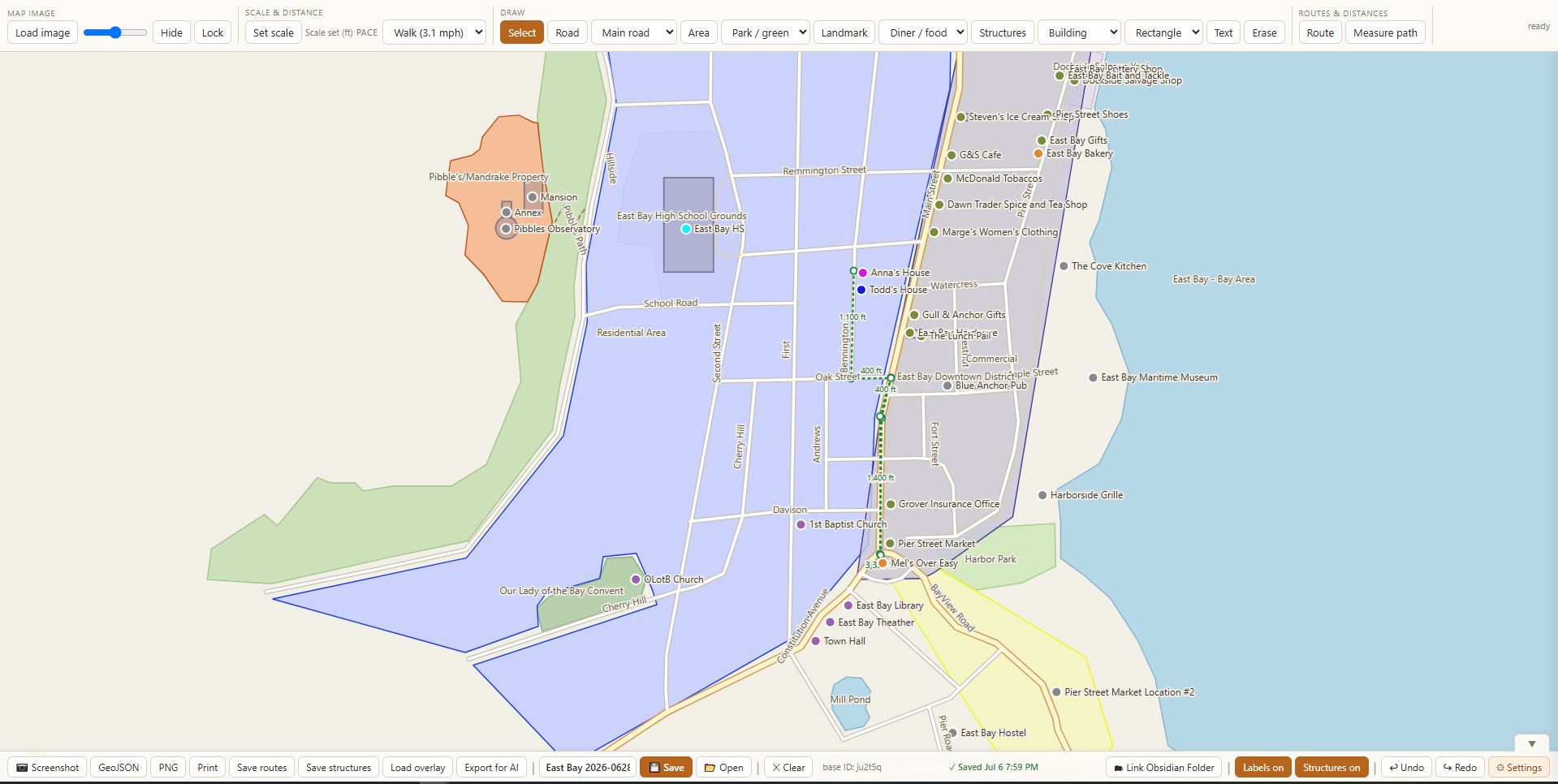
That allows me to easily map Anna’s route to Mel’s:
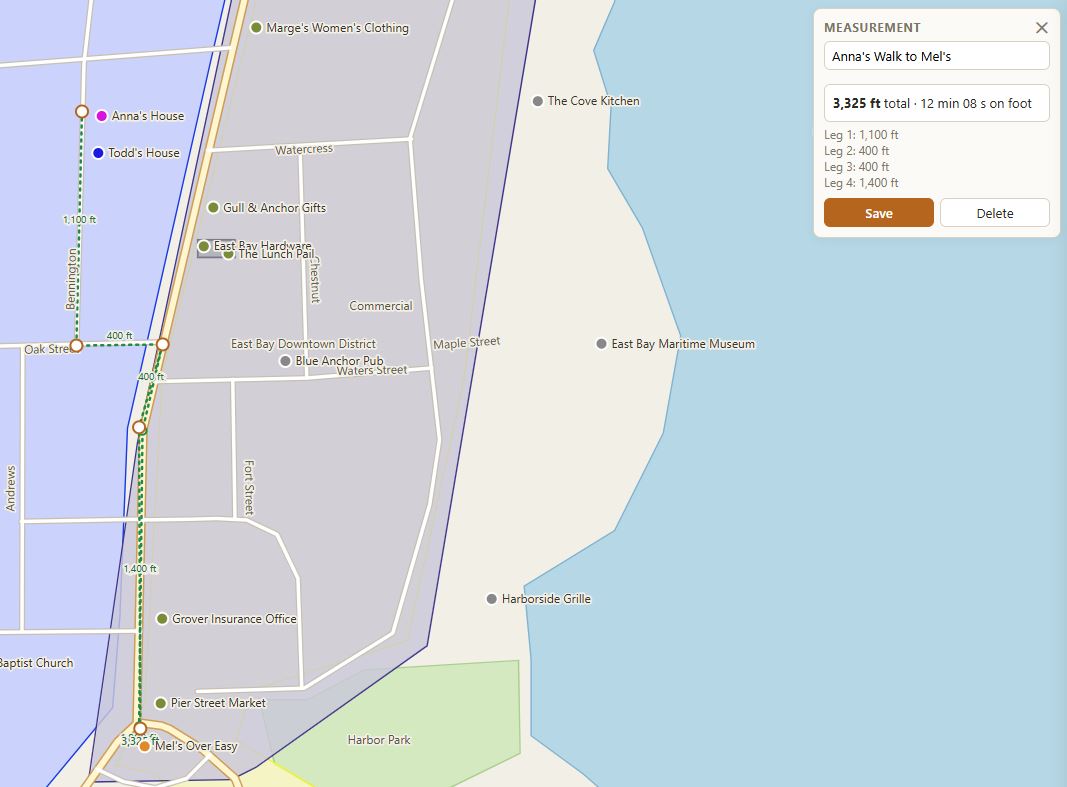
The app calculates all of that for me, so, for example, I could run a route, and say, “Anna goes from her house to Mel’s. That’s 12 minutes. I need to write the feeling of 12 minutes passing in the scene.
Mapping an entire town is probably overkill for most projects. But when I was sitting two chapters into Charles Mandrake and the Return to Skelderheim, and Anna and Todd crossed back into East Bay to rejoin Charles as the “trio,” I knew then I needed the town to remain consistent to the first book. That was really the hardest part. I had the luxury of making things up as I wrote the first book. Book Two was completely in the Central Expanse, across the portal. Book Three they came back, and I needed the characters to feel like they were coming home to a place that was home, and that they were intimately familiar with.
When I started in on the East Bay website, after Book Three, and Azaya and the Streets of Skelderheim were finished, I built the formal map you see above. It was more critical to get times and locations correct there. If anything was going to feel inconsistent with the books, it would be the site.
This is just one layer of the magic in making a place feel real across transmedia. As an author, we want our readers to truly enjoy the books we write. This is an edge case: most authors don’t create dedicated book series sites, and even fewer create town sites for locations in their series. Very few attempt this.
For now, this is just one of the ways, and a minor one, on how you can keep an entire town consistent across a long-term book project.
Somewhere in the future, I’ll talk about character consistency, maintaining a voice throughout an entire transmedia project, and why I decided to model the Mandrake project like a franchise.