
East Bay Date:
December 24th, Christmas Eve
Skelderheim
Charles had not realized how much he missed the sound of a fire until he could hear this one without thinking about generators, gauges, or what might be humming under his boots.
The copper hood over Rell and Emera’s hearth caught the firelight and sent it into the common room. Someone had hung short bundles of dried green along the mantle. It was not pine, but it was close enough that he could pretend for a while. The place smelled like smoke, stew, and fresh bread. It was different from Mel’s on a winter morning in East Bay, but the steady warmth of a full room felt familiar.
He sat in a worn armchair close to the fire. Anna was in the chair to his left. Todd sat to his right in a chair that sagged a little more. Their boots were damp from the walk and had started to steam where the heat reached them. Behind them, the room was busy but not loud. Most people had already eaten. Talk had settled into a low run of voices and the crackle of the fire.
If Charles kept his eyes on the flames, he could almost imagine he was in the observatory annex with the small heater ticking and a notebook on his lap.
Almost.
He knew better than to forget where he was.
In the far corner, near the back wall, Izrah stood with her hands folded in front of her. She wore a long dark coat over her armor. To most people in the room she would look like a traveler standing out of the way. Charles watched the way she kept her back to the wall and let her eyes move slowly over the room. He had learned that pattern well enough.
Two other figures stayed near the doorway. Their clothes were plain. They held simple cups and did not draw attention, but their attention never fully rested. Charles knew the shape of guards now the way he knew the layout of the observatory. Once he understood it, he saw it everywhere.
Anna knew too. She sat angled just enough that she could see Izrah if she wanted without being obvious about it. Todd looked more interested in his mug and the plate of fried bread on the table between them, but Charles was sure he had counted exits the moment they came in.
Emera moved through the room with a tray in hand and a cloth at her waist. Rell stood behind the counter, wiping a glass that was already clean. People here trusted that as long as both of them were relaxed, the night was fine.
Tonight, they looked relaxed.
“Feels like Christmas,” Todd said, watching the fire. “If Christmas came with more leather and less tinsel.”
Anna snorted. “We do not even have tinsel at home.”
“Mel has that sad string of lights,” Todd said. “The one she pretends works every year.”
“She keeps it because people expect to see it,” Charles said. “People expect certain things in December.”
Anna met his eyes. He saw the small crease appear between her brows, the one that meant she was thinking about two places at once.
“It feels like both,” she said quietly. “Not Christmas the way we know it. But like we brought some of it with us when we walked in.”
Charles guessed Anna’s thoughts were back in East Bay. He could picture Mel taping paper snowflakes to the diner windows and setting out the crooked sugar cookies that always came out a little burnt at the edges. He imagined the harbor lot filling with trucks, boots stomped clean at the door, people saying they were just in for coffee and staying through breakfast. However far Skelderheim felt, the idea of Christmas still meant that harbor and that diner more than anything else.
Here, the dim sun sat over the city the way it always did. There were no lights on doorways, no wreaths on windows. The only evergreen he had seen grew on the slope below the inn.
Still, sitting by this fire with Anna and Todd, it felt closer to Christmas than anywhere else on this side of the ring.
The door opened. Cold air slipped in with a bit of street noise. The sound in the room stopped at once. Voices broke off in the middle of words. Chairs froze halfway back to the floor. Even the clack of dice at a table near the wall cut short.
Every head turned toward the door.
Charles looked up out of habit.
Myles Pibbles stood there with a small tan canvas pack over one shoulder. The pack looked used but well kept. His beard was neatly trimmed. He wore a dark three-piece suit. Charles had seen suits like that at formal events in East Bay. Here it made Myles stand out even more. It marked him as a man who came from somewhere else and chose to be here tonight.
For a few heartbeats no one spoke. People stared at him the way they might look at a story that had stepped off a page. Then someone near the back bowed their head. Another person touched two fingers to brow and chest. The rest of the room followed in smaller ways. Only after that did talk start up again in low, careful voices.
Myles nodded to Rell at the counter and to Emera as she passed. A few regulars called out to him by title or name. He answered with short greetings and a nod.
Near the wall, two children sat on the floor with a carved cart between them. When Myles reached them, he stopped. He crouched to their level and reached into his coat pocket.
“Is your cart short a driver?” he asked.
The boy and girl both nodded.
Myles brought out two small wooden figures, simple and smooth. One looked like a sailor with a hat carved in one quick shape. The other was a small horse with four sure legs. He set the sailor in the cart and placed the horse at the front.
“There,” he said. “Now it has someone to steer and something to pull it. They have seen many roads. I think they will like this one.”
The children stared at the toys, then at him.
“Thank you, sir,” the girl said.
“Take good care of them,” Myles said.
They promised they would. He rested a hand lightly on the boy’s head, then straightened and moved on.
Charles watched the way he walked through the room. There was no hurry in it. It was the same measured pace Myles used in the observatory at the house in Skelderheim. He never seemed rushed, but he always seemed to arrive when he meant to.
When he reached their corner, Rell came over with an extra chair. It was not one of the stools from the tables. It was a wide armchair with a high back and worn leather arms.
“Best seat in the house, Inventor,” Rell said as he set it down by the fire.
Myles gave him a small smile. “You keep saying that,” he said. “I am starting to think you believe it.”
Emera followed with a mug on a small tray. She set it on the low table within his reach.
“For you,” she said. “Something hot. The cold cuts deep tonight.”
“Thank you,” Myles said. “You keep this room warmer than the street outside. That matters.”
Rell stepped back. The room settled again.
Myles set his pack down next to the armchair and sat. He let out a quiet breath as if he had been standing a long time.
He looked at each of them in turn. His eyes rested on Charles last.
“Good evening,” Myles said. “Or Merry Christmas, if we are going by East Bay’s calendar.”
The word sounded out of place here. It belonged to another harbor, another sky.
Todd’s face brightened. “So it is Christmas there now?”
“Christmas Eve,” Myles said. “Snow in the harbor. Lights in Mel’s front window. A big tree in the town square. The day itself is about those around us.”
Anna shifted in her chair. “Do people here celebrate it?” she asked. “In Skelderheim?”
Myles shook his head. “The city has other winter days. Bells and lamps. More remembrance than celebration. Christmas is from our side of the ring. I keep it mostly by telling stories, but now that you’re here, I have people who understand the traditions.”
He wrapped his hands around the mug Emera had left. Steam curled up between his fingers.
“When Gracie was five,” he said, “we had a winter that did not want to end. Snow up to the lower windows. Ice on the lines. We kept candles ready in every room and left a kettle on the stove all day.”
Charles pictured the house on the hill under that kind of snow. He imagined the observatory above it, dome closed, metal cold.
“Her mother wanted Christmas to look the same no matter what the weather did,” Myles said. “Tree in the front room. Lights that would not work until the last minute. The usual trouble.”
He said it without drama. The name that came next carried the same steady tone.
“Martha made it feel calm,” he said. “She had a way of making a day feel ordinary and important at the same time.”
Charles had seen her name in margins and on an old photograph. Hearing it now put it back into a real room.
“Gracie woke before dawn,” Myles said. “As most children do on that morning. She walked down the hall in slippers her grandmother sent. They were too big for her feet and looked a little ridiculous. She climbed onto our bed and announced that it was Christmas and time for presents.”
Todd smiled into his mug.
“We told her she had to wait until the kettle boiled,” Myles said. “That was the rule. Hot tea, then paper on the floor. She stood on a chair in the kitchen and watched the steam. She said she could tell the exact moment it was ready by sound alone. I am not sure she was wrong.”
He paused for a moment, then went on.
“We gave her three things that year,” he said. “A small book with pictures and simple words, because she said she was ready to read. A set of paints in a wooden box her mother had used when she was a girl. And a little brass telescope that did not do very much but made her feel like she could see farther than the end of the yard.”
He looked at Charles.
“She carried that telescope outside into the snow with no coat,” he said. “Pointed it at the sky and said she could see the new year coming. We had to bring her back in before she froze herself.”
Anna’s mouth curved. “Did she keep it?”
“For a while,” Myles said. “Children grow. Toys do not. But she went to sleep that night with paint on her fingers and the telescope close by. That was enough for me.”
The fire popped. Someone laughed quietly across the room. The three of them sat still for a moment, letting the picture settle.
Myles rested a hand on the canvas pack at his side.
“You are far from home,” he said. “Farther than I ever meant anyone to be because of my work. I cannot give you your own tree or Mel’s broken lights. But I can give you something from the kind of night I remember.”
He pulled the pack onto his lap and opened it.
Charles felt his attention sharpen. Gifts were pleasant. Here, objects often meant more than they looked like.
Myles took out a small wooden box first. The lid was carved with neat straight lines and circles. He turned to Anna and set it on her knees.
“For you,” he said. “From a place that has not seen you yet and from another that never will.”
Anna lifted the lid. Inside, on a piece of dark cloth, lay a necklace. The chain was thin but solid. At the center was a setting of small clear stones around a single blue crystal, a little larger than the others. The cut was simple.
The firelight caught in it and showed a deep blue, like water beyond the breakwater on a clear day back home.
“It is pretty,” Anna said. Her voice was even.
Myles nodded. “The small stones are common,” he said. “The center is not. The mineral is called fragimite. You will not find it in East Bay. It comes from a steppe far east of this city, past low hills and the tall mountain ranges.”
He looked toward the fire.
“In complete darkness it gives off a soft blue light,” he said. “Enough to see nearby. Not enough to call attention from far away. It is useful when you need to see your own hands, read a book, or pour coffee before dawn. It is less useful if you want to vanish. It should be tucked under the shirt when unneeded.”
“Is it dangerous?” Charles asked.
“Not to you,” Myles said. “Not in that size. It stores light more than anything else. Treat it like any other tool that behaves in a way you are still learning.”
She removed the necklace from the box and handed it to Myles. She turned her back to him and lifted her hair with one hand, pulling it forward over her shoulder to clear the back of her neck. Myles rose a little in his chair, took the necklace from its cloth, and stepped close enough to fasten it for her. His hands were steady and careful. When the clasp clicked, Anna lowered her hair again and touched the pendant once to feel its weight. She turned back to him and gave him a hug.
“Thank you,” she said. “I will use it carefully.”
“I trust you will,” Myles said.
He turned to Charles and reached into the pack again. This time he brought out a thin leather folder. It looked like the kind used to carry papers flat. He handed it over.
Charles opened it. Inside was a single sheet of stiff paper. A floor plan had been drawn on it with neat lines. There was a narrow front room, a small back room, and stairs to an upper level. Measurements ran along the edges in local units.
At the bottom, in Myles’s handwriting, was a short note:
Mandrake’s Accounting House, home office. Keys held in trust. Purchased outright. No rent.
“This is a shop,” Charles said. “In the Market Ward.”
“A small one,” Myles said. “Near the rope sellers and the ledger keepers. Right on the Market Square. Prime ground. People from every ward pass that corner each day. You spoke about starting a service that helps people instead of something they avoid. You said you wanted to start an accounting house that merchants could use so they didn’t have to worry when dues came about. There are many here who need that.”
Charles felt the pull of the idea. He could see chalk on walls, ledgers lined up, maps with marks that meant something. He could picture people bringing him questions about trade, routes, and debts.
“Thank you Mr. Pibbles,” he said. “I’ll start up at the turn of the year… in East Bay time of course.”
Myles nodded. “Good to hear. The place is meant for the life you build here. The keys are in my study on the hill when you want them.”
Todd leaned over to look.
“Mandrake’s Accounting House,” he read. “Sounds official.”
“That is the point,” Myles said.
Charles closed the folder and held it carefully.
“Thank you,” he said again.
Myles’s eyes softened.
“You have already done more work than I had any right to ask of you,” he said. “Call it a return on that.”
He reached into the pack one more time and took out a glass bottle about as long as Charles’s hand. Inside, on a painted bit of blue, sat a small ship. The hull was simple and clean. A single mast held a plain sail. The cork at the top had been sealed.
Todd’s mouth was already open by the time Myles turned toward him.
“For you,” Myles said. “A small picture of a larger thing.”
Todd took the bottle with both hands.
“It is a good shape,” he said after a few seconds. “It would ride well if it were real.”
“It is real,” Myles said. “I had both the ship and the model made together. The one in the bottle is an exact copy of one in the harbor. Same lines. Same sail. Same deck. The builder did good work.”
Todd looked up.
“There is a real boat?” he asked.
Myles nodded. “Tied up and waiting. The bottle is a promise. The boat needs a captain who listens to water and wind. I am told you know how to do both.”
Todd sat back a little, still holding the bottle.
“I do not have money for a boat,” he said.
“You have time, hands, and the sense to ask for help,” Myles said. “The boat itself is covered. The work after that is yours.”
Before Todd could say anything else, a familiar voice spoke just behind his chair.
“If you take her out,” Sella said, “you will need a first mate.”
Todd almost dropped the bottle. A hand settled on his shoulder and steadied him. It belonged to Harrick.
Harrick stood beside him with his usual quiet presence. Sella was on his other side, chin up, eyes bright.
Todd looked from the bottle to Sella and then to Harrick.
“First mate,” he said. “You mean on the boat.”
Sella smiled, not wide, but steady. “On the boat to start,” she said. “It is easier to learn a new boat when you have the same person beside you day after day. Someone who plans to stay with the crew they choose, not just pass through.” She knelt beside Todd’s chair and put her hand on his arm.
Todd frowned a little, sorting her words. “Well,” he said, “a boat does better when people stick with it.”
Sella’s eyes warmed. “It does,” she said. “And so do the people on it.”
Harrick gave a short, approving nod.
“She knows her nets and the wind,” he said. “And I have seen worse choices for a partner than a boy who can keep a boat upright and do what he says he will do. If you want the work, you will not be doing it alone.”
Todd’s ears had gone a little pink. Charles looked down at the floor for a moment to give him room.
“I would like that,” Todd said. “The boat. And the first mate.”
Myles sat back in his chair. The firelight showed the lines at the corners of his eyes. He looked tired, but there was a steady satisfaction in his face as he watched them all by the hearth on this strange Christmas Eve.
Emera came by a little later with the pot to refill his mug. She moved the same way she did when the room was full and loud, steady and quick, but he could see the fine edge of the day in her shoulders.
“Top you off?” she asked.
“Please,” he said. He waited until the mug was almost full before he spoke again. “Emera, before the night runs away from us—may I trouble you and Rell for one more thing?”
Her mouth pulled to one side. “You have already done plenty just by walking through that door, Inventor.”
He shook his head. “That was for me,” he said. “This is for them.” He nodded toward the three by the hearth, then wider, taking in Sella, Harrick, the guards who had relaxed by inches, and the regulars who had begun to smile again.
“What kind of trouble?” she asked.
“A meal,” he said. “A proper one. Bring out what you keep for high days. Roast, root vegetables, what the harbor gave you this morning. And enough ale that no one has to count during the first round.”
Emera’s eyes widened a little. “For your table?”
“For the room,” he said. “Call it Christmas if anyone asks. It is a quiet thing. No speeches. Just plates that do not run empty too fast.”
“Myles,” she said, dropping his title for a beat, “we cannot afford to open the taps like that.”
He reached into his inner pocket and brought outthree leather coin bags tied with gold thread, marked with the Inventor’s emblem. His personal bags of coin worth more than any other coin bag in the city, but so seldom seen, the bags were almost as much a myth and legend as the Inventor. Along with the coin bags, he produced a plain envelope, folded once. The paper was thick. A small seal in dark wax marked one corner with the simple crest of the Scholar’s quarter.
“You can,” he said. He slid it onto her tray so only she could see. “The bags cover tonight. And a little more for your kindness and generosity.”
She frowned and moved the tray just enough to read the first line on the front. Her name. Brell’s name. Their son’s names written beneath in his careful hand.
“What is this?” she asked.
“Letters of sponsorship,” he said. “Upper Scholar’s quarter. Full tuition, board, and all materials for both boys, should they wish it. The registrar will expect you when the time comes. All dues are paid by my house.”
Emera went very still. The pot in her hand did not move.
“That is too much,” she said quietly. “We feed you. That is all. We do not take this kind of thing.”
He met her gaze.
“You keep this house safe,” he said. “You welcome people who carry more trouble than coin. You gave three strangers a place by your fire when you had every reason to turn them away. You have earned more than a few letters and a full table.”
She shook her head once, on reflex. “I cannot accept—”
“In this city,” he said, “it is polite to refuse a gift once. I have heard the protest. Now you will let me do what I intend.”
Emera’s jaw worked for a moment. Then she let out a slow breath.
“You and your rules,” she muttered. “Thank you. We will make good use of it. For them.”
“For them,” he agreed.
She slipped the envelope under the corner of her apron and straightened.
“All right,” she said, voice brisk again. “We will need another table pulled to the middle and every plate we own. I hope your ‘Christmas’ knows what it is asking for.”
“It usually does not,” he said. “That is half the point.”
She snorted and moved off toward the kitchen.
Brell appeared not long after, wiping his hands on a clean cloth.
“Emera says you are trying to ruin us with generosity,” he said.
“Only for tonight,” Myles said.
“We cannot let you pay for the whole house,” Brell said. “It is not right.”
“It is already done,” Myles said. “If it helps, think of it as an experiment in morale. You provide the conditions. I record the results.”
Brell opened his mouth, closed it, then let out a short breath.
“As is custom,” he said, “I will say once that it is too much. There. Now I will say thank you.”
“You are welcome,” Myles said.
Brell’s face softened.
“We will make it a night they remember,” he said. “That much, I can promise.”
He clapped Myles lightly on the shoulder and went back toward the kitchen, already calling out orders.
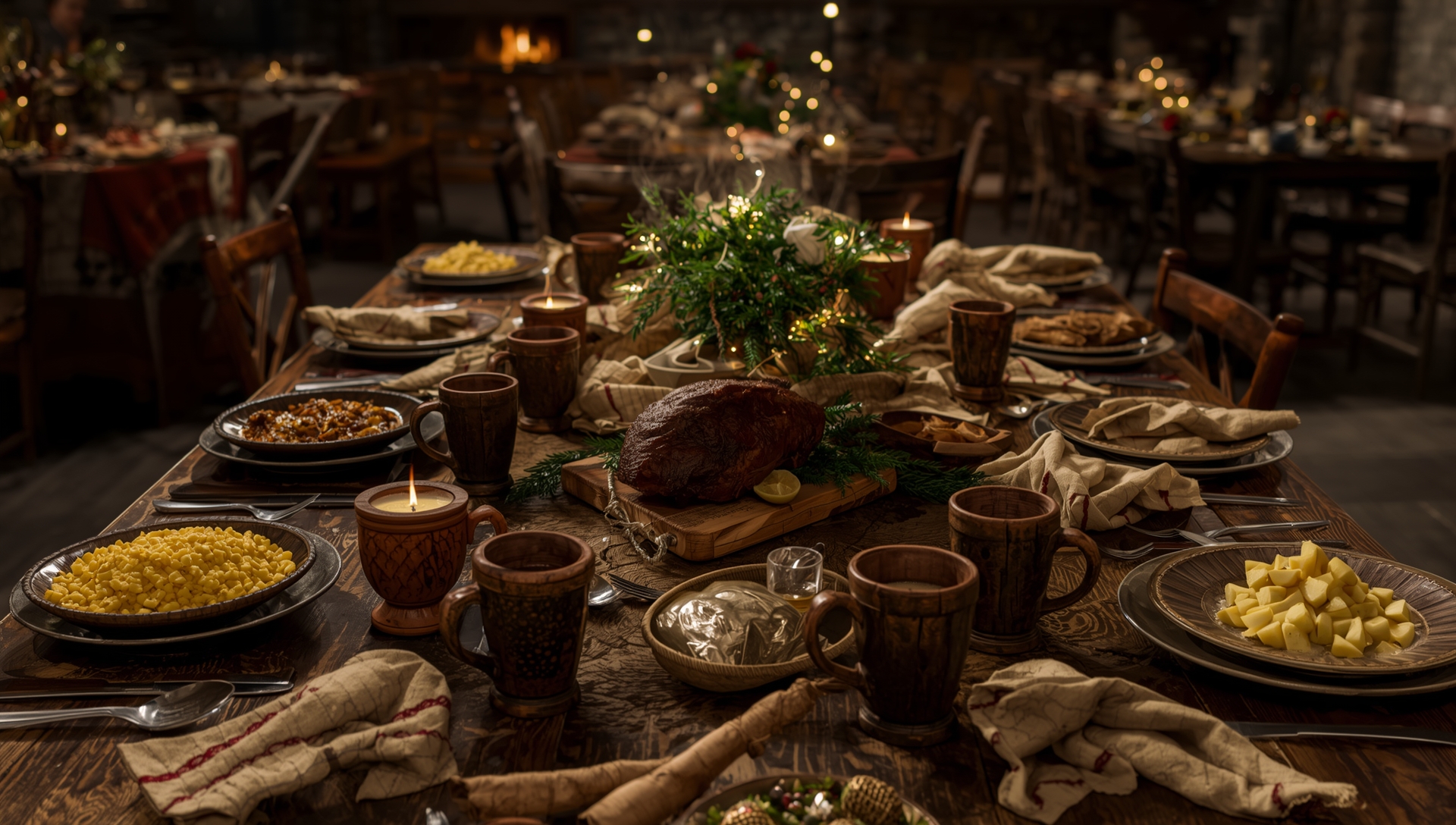
The inn shifted as the work began. Extra tables appeared in the middle of the room. Benches slid into place. A long board was cleared and wiped down. The air picked up the sharper smells of roasting meat and herbs as ovens were opened and closed.
Before he let himself settle, Myles pushed up from his chair and joined the work. Charles, Anna, and Todd followed without being asked. Together they moved tables to the center, straightened benches, and set out clean plates. Even Izrah stepped forward for a moment to lift a heavy board into place before returning to her corner.
When the biggest of the tables had been set, Myles turned to her. “Izrah,” he said quietly, “join us tonight. As a guest. Put the guard down for one evening.”
She hesitated. “It is not my place.”
“It is,” he said, “because I am asking.”
She gave the single polite protest expected of someone in her role, then inclined her head. “Very well. For tonight.”
Only then did Myles return to his chair, hands resting easy around his mug.
He let his focus drift from face to face. Charles sat forward a little now, the folder still close at hand, the expression of a young man already turning over plans in his head. Anna held the closed box with the necklace, thumb resting on the lid, talking quietly with Sella about something that made both of them smile in small, real ways. Todd kept glancing at the bottle in his hands and then at the door, as if half expecting the boat itself to come crowding through it.
Izrah stayed where she was in the corner, but her shoulders had loosened. Harrick and the plain-clothes guards had let themselves blend further into the room. They were still watching, but it looked less like tension now and more like habit.
The people of the tavern shifted too. Regulars leaned in to hear the promise of free ale and extra food. A pair of older men by the far wall began arguing cheerfully about which winter catch made the better chowder. One of the children with the wooden cart drove it in small circles under the table, horse and sailor bumping gently against chair legs.
Myles felt the room warm in a way that had nothing to do with the fire.
Skelderheim had not been kind to him at first. It was a city that remembered more pain than joy, a place where people watched the sky and the streets both for signs that old damage might return. He had lived many nights alone with his work, with only the quiet talk of the Veil and the steady routines of the tower and his mirror observatory for company.
He had told himself that was enough. That purpose could stand where family used to be.
Looking at the ring of faces around the hearth now, he knew better.
It was a simple thing, seeing Charles lean over to say something low to Anna that made her roll her eyes and smile anyway. Watching Todd tilt the bottle to catch the light, already talking with Harrick about lines, nets, and costs as if the boat were a problem he could solve with his hands. Seeing Sella stand a little closer than custom required with a hand on his back. Hearing Rell’s laugh from the counter as someone at the far table raised a mock toast to “the man who pays for the good beer.”
He thought of Gracie at five, on a chair in the kitchen, listening for the kettle. He thought of Martha making sure there was always one more plate than there were people at the table, “just in case,” she would say. He thought of the house on the hill in East Bay and the house on the ridge above this harbor, and how both of them felt less like buildings and more like doors that had been left open.
Tonight, for the first time in a long while, he did not feel like the man standing alone in the doorway.
Emera and Brell began carrying out the food. The first to arrive was the roast, still glistening from the glaze that had caramelized in the heat of the oven. It gave off a rich, savory smell that filled the room as soon as it hit the table, the fat crackling softly where the knife would cut. Bowls of root vegetables followed, piled high with carrots, turnips, and golden potatoes, each one soft enough to fall apart under a fork, steam rising in thick curls. Then came the chowder—two heavy pots carried with care—thick and creamy, full of fish pulled from the harbor that morning, seasoned with herbs that lifted on the air and made the whole tavern smell like a warm kitchen on a cold day. Pitchers of ale moved from hand to hand until every mug was full.
Myles looked toward the counter and caught Brell’s eye. “You and Emera should join us,” he said. “Bring the boys too. Tonight is for everyone.”
Brell gave the expected single protest. “We ought to be serving, not sitting.”
“You’ve served enough,” Myles said. “Sit with us.”
Emera appeared a moment later with both sons in tow. They were about seventeen, tall and unsure of where to stand. Brell guided them forward, and the family took places at the long table. When they settled, the whole room seemed to wait, eyes turning toward Myles as if expecting the next line in the story.
Myles raised his own in a quiet gesture, not high enough to call for a speech, just enough that those watching him could see.
“To those who found their way here,” he said, voice low but sure. “And to the ones we carry with us when we are alone.”
Only a few nearby heard the words clearly, but the room answered all the same with the soft clink of mugs and the first bites of a meal that would be remembered long after the plates were cleared.
Merry Christmas from Skelderheim.
About author